Does a city have an expression?
We recognize a city through its infrastructure and landmarks, and remember it through historical events and local specialties. These impressions of a city accumulate over years and continue to be renewed. They are images that surface naturally in the mind, yet they are not simply images. Like the expressions on people’s faces, the impressions of a city are not flat, isolated frames, but connections filled with emotion and bodily memory, connections that have thickness. The expression of a city exists within each of us.
The Image of the City: Between Rumor and Truth
In Invisible Cities, Italo Calvino describes fifty-five cities, revealing at the end of the book that they are all images of Venice. It shows us that a city exists within multiple narratives and multiple realities. “The city itself is a meaningful and readable text. Those who live within it are the writers of that text, continuously writing the city through their practices—dwelling, walking, and all kinds of other activities.” (Italo Calvino, 1972). People continually shape the city and write its expression together, while each reads it in a different way. The image of a city therefore seems, at first, difficult to name and impossible to grasp.
Invisible Cities also tells us, “Memory’s images, once they are fixed in words, are erased.” (Italo Calvino, 1972). The image of a city is always in motion; it seems that a city can never be captured simply through words or images. The same uncertainty appears in Yi-Chang Juan’s photographic collection Taipei Rumor. The Taipei of the last century no longer exists, and the Taipei that once was has become something like a rumor. Is every present we experience also another layer in the accumulation of “rumors”?
The afterword of Taipei Rumor says: “I finally understood that beautiful times always exist. In every corner of society there are moving deeds and kind people. Everything is made by the mind. To me, Taipei is no longer a rumor.” (Yi-Chang Juan, 2012). The small fragments that unfold within a city, each story of the city, are its “truth.” A city is made by folding together culture and history, legends and beliefs, great landscapes and unnamed everyday life. The city exists between rumor and truth.
A Fractured Beitou: The Cuttlefish City
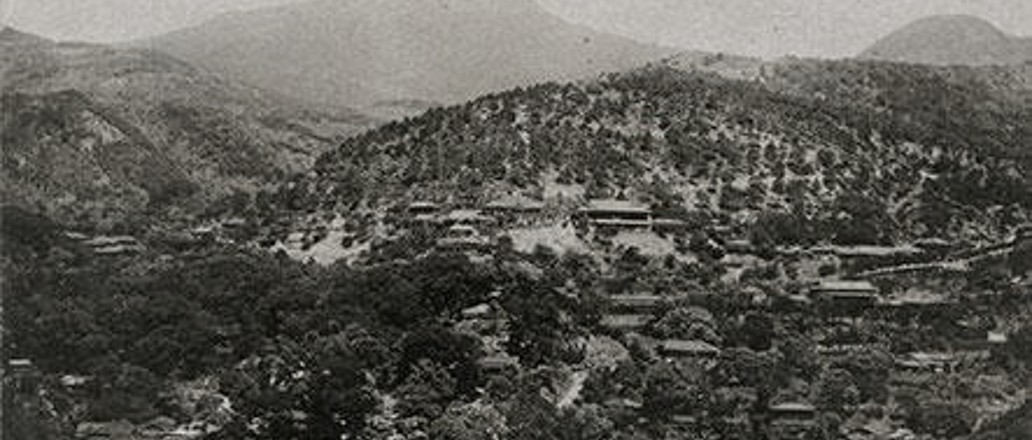
Under the tide of globalization, the past is buried and cultural differences are leveled. The expressions of many cities gradually become the same. Beitou, for example, has lived beside the Yangmingshan mountains. Over centuries, the Plains Indigenous peoples, Han settlers, and Japanese residents inscribed themselves onto this land. The old Beitou community grew along the railway into the settlement of Xinbeitou, then extended into the mountains, clustering terrace by terrace along the contour lines. Life and nature were interwoven, and the relationship between people and the mountains was close.
But under the compressed time and space of modern life, the settlement began to grow densely toward the sky and detach itself from the mountain terrain. The connection between people and the land has been diluted. Some of Beitou’s colors are fading. The Beitou facing the mountains and the Beitou facing the expansion of the city pull against one another, leaving the city in a fractured state, like a cuttlefish in the deep sea, displaying two patterns like a spy as it faces opposing environments.
Facing a Deforming Everyday… Constructing a “Contemporary Urban Memorial”
The memory of the city quietly retreats into the depths of everyday life, while the relationship between people and land is challenged. How can the daily life of Beitou’s people remain in Beitou? The city keeps changing between disappearance and renewal. Could we use place as a medium to remember our land, our lives, and our time?
“Architecture ‘lives’ within people’s lives, changing as their lives change, until it becomes their ‘collective memory’… The history of a city is never only the historic buildings within it, but the history of how architecture has ‘lived.’” (Li-Chun Lee, Yao-Ting Wu, & Jie-Ting Xie, 2019). By weaving clues of time and space through a “contemporary urban memorial,” the everyday life of Beitou can be anchored to this land and continue, through the current of time, as a witness to the city.
A Reader of Urban Memory
History, culture, memory, and emotion are dynamic. Yet Beitou’s existing vessels of memory—its museums, monuments, and others—are rigid and partial, institutionalized, carrying predetermined postures and positions. They cannot move forward or continue, nor can they faithfully reflect what is called local culture. Like a single rumor or truth about the city, each is only an excerpt from a fragmentary story and cannot speak for Beitou.
Beyond this kind of institutionalized collection and display, what other possibilities might exist for Beitou’s emotional memory, or for the history and culture of a place? And what form could carry the culture, memory, and emotion that belong to our own time?
“If you search for intimate relationships within traditional forms, your efforts will be in vain;… what interests us is everything that has not yet been thought, the long-range, the distant future……” (IT Park, 2010). At the end of the last century, in resistance to an art ecology constrained by museums and gallery spaces, alternative spaces such as IT Park and Apartment No. 2 appeared. Looking back, they did change artistic habits and helped art break through its limits.
Thinking through the same framework, Beitou’s “alternative space” as a vessel should emerge from local culture, embody truth while also carrying rumor, preserve its autonomy, and remain free to receive new meanings while holding the values of this time. By introducing a human coordinate system into the land, it can emphasize the connection between life and the city, describe the city’s history through urban public places, and create a memorial ground belonging to Beitou.
References
- CHEN, YU-XIU (2021) "Jia Mountain, Cultural Museum, Centennial Celebration". Egret Cultural and Educational Foundation.Retrieved from http://egretfnd.org.tw/new29.html (Accessed: 2023/12/30)
- Italo Calvino (1972) Invisible Cities. Translated by WANG, ZHI-HONG. Le città invisibili. Published on 1993/11/15 by Times Publishing.
- JUAN, YI-CHANG. Taipei Rumor 1975-1988. Published on 2012/04/25 by Flâneur Culture Lab.
- LEE, LI-CHUN, WU, YAO-TING, XIE, JIE-TING (2019/07/05). Forgetting in Life, Remembering in Forgetting: A Historical Reading of Cities, Architecture, and Monuments. CLABO Experimental Waves.Retrieved fromhttps://mag.clab.org.tw/clabo-article/historical-reading-of-cities-architectures-and-monuments/(Accessed: 2023/12/30)
- IT Park (2010). "About IT Park". ITPARK.Retrieved from https://www.itpark.com.tw/preface (Accessed: 2023/12/26)